
8 Reasons Your Bookkeeping Is Holding Back Your Business
You started your business to build something meaningful. To solve problems, serve customers, and create the life you envisioned. Somewhere along the way, the books became an afterthought.
Maybe you're still using that spreadsheet you cobbled together in year one. Maybe you've got a shoebox full of receipts that you'll "get to eventually." Or maybe you're just hoping your accountant can sort it all out come tax time.
Here's the hard truth: disorganized, neglected, or inaccurate bookkeeping doesn't just create headaches at tax time. It actively holds your business back from the growth you're working so hard to achieve.
Good bookkeeping isn't just about compliance or keeping the IRS happy. It's the foundation that unlocks everything else—meaningful financial reports, realistic budgets, accurate forecasts, and real accountability for your growth goals. Without it, you're flying blind.
Let's look at eight ways your current bookkeeping situation might be standing between you and the business you're trying to build.
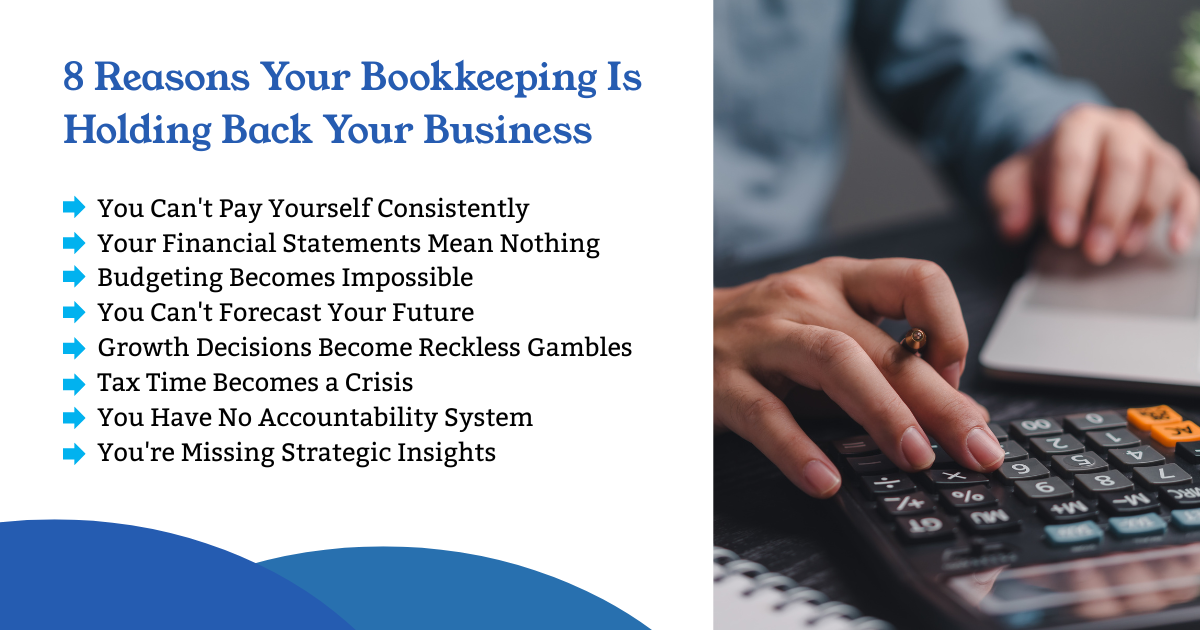
1. You Can't Pay Yourself Consistently
One of the most common struggles we see with business owners is the inability to take a consistent paycheck. They're profitable on paper, but cash seems to disappear into the ether. When your bookkeeping is messy or months behind, you have no real visibility into your cash flow. You don't know what's coming in, what's going out, or what's left for you.
Accurate, up-to-date bookkeeping gives you the clarity to pay yourself like the professional you are—not whatever happens to be left over at the end of the month.
2. Your Financial Statements Mean Nothing
A profit and loss statement is only as useful as the data behind it. If expenses are miscategorized, revenue is recorded in the wrong periods, and account reconciliations haven't happened in months, your financial statements are essentially fiction. They might show you're profitable when you're actually bleeding cash, or they might understate your success when things are going well.
Meaningful financial reports require clean books. Period. When your bookkeeping is accurate and current, your P&L, balance sheet, and cash flow statement become powerful tools for decision-making instead of just documents you hand to your accountant once a year.
3. Budgeting Becomes Impossible
How do you create a realistic budget for next year if you don't have accurate data from this year? You can't. Without proper bookkeeping, budgeting becomes a guessing game. You might dramatically underestimate certain expenses or fail to account for seasonal patterns in your revenue. You'll set targets based on hopes and feelings rather than historical reality.
Good bookkeeping provides the historical data you need to build budgets that actually mean something—budgets you can use to guide decisions about hiring, marketing spend, equipment purchases, and growth investments.
4. You Can't Forecast Your Future
Forecasting is where financial data becomes truly strategic. Will you have enough cash to make payroll in three months? Can you afford to hire that new team member in Q3? What happens to your margins if a key vendor raises prices?
These questions require solid historical data as a starting point. When your bookkeeping is in disarray, forecasting becomes nothing more than wishful thinking. You can't model different scenarios or plan for contingencies when you don't even know where you stand today. As we discuss in our year-end accounting guide, understanding your cash flow is perhaps the most critical aspect of financial planning—and that understanding starts with accurate books.
5. Growth Decisions Become Reckless Gambles
Thinking about expanding your services? Opening a new location? Bringing on additional staff? These decisions require financial clarity. Without accurate bookkeeping, you're essentially gambling with your business's future.
Business owners with clean books can answer critical questions: What's our true cost to acquire a customer? What's our profit margin on each service line? How long will it take to recoup this investment? Those without clean books are left guessing—and guessing wrong on major decisions can sink even the most promising businesses.
6. Tax Time Becomes a Crisis
We've all seen it: the business owner who shows up in March with a year's worth of bank statements and a panicked look in their eyes. They've spent the last few weeks scrambling to reconstruct an entire year of financial activity. They're stressed, their accountant is stressed, and the whole process costs more than it should.
Worse, the rush leads to errors and missed opportunities. Deductions get overlooked. Expenses get miscategorized. Tax planning strategies that could have saved thousands are impossible to implement because the window has closed. Your year-end financial process should be an opportunity for strategic planning, not a last-minute scramble.
7. You Have No Accountability System
Financial goals without accurate tracking are just wishes. You might tell yourself you want to increase revenue by 20% or reduce operating expenses by 10%, but without proper bookkeeping, how will you know if you're making progress? How will you identify what's working and what isn't?
Good bookkeeping creates accountability. It gives you real numbers to measure against your targets. It shows you when you're drifting off course so you can make adjustments before small problems become big ones.
8. You're Missing Strategic Insights
When bookkeeping is treated as a compliance chore—something you do because you have to—you miss out on its strategic value. Accurate financial data can reveal which customers are most profitable, which services are underperforming, which expenses are creeping up, and where your biggest opportunities lie.
The business owner who knows their numbers has a competitive advantage over the one who doesn't. They make faster decisions, take smarter risks, and catch problems earlier. They're not just running their business—they're steering it.
The Path Forward
If any of these scenarios sound familiar, you're not alone. Many business owners start out handling their own books and simply outgrow that approach. Others inherit messy systems from previous bookkeepers or accountants. Whatever the cause, the solution starts with getting your financial house in order.
Good bookkeeping isn't about perfection or complexity. It's about accuracy, consistency, and timeliness. It's about having reliable financial data that empowers you to make confident decisions about hiring, expansion, compensation, and growth investments.
When you know your numbers, everything changes. You stop making decisions based on fear or guesswork. You start making decisions based on facts. And that's when real, sustainable growth becomes possible.
Whether you're getting ready for year-end, struggling with cash flow, or simply tired of the uncertainty, there's a better way. The right accounting partner doesn't just prepare your tax returns—they help you understand your cash flow, identify opportunities, and ensure your financials tell the accurate story of your business.
Your business deserves better than messy books. And so do you.